
NEWS & INSIGHTS
Chemical Industry Updates & Company News
Send Us A Message
How to Select Diammonium Phosphate Grades for Soil Fertility Programs
How to Select Diammonium Phosphate Grades for Soil Fertility Programs
Selecting the right Diammonium Phosphate grade begins with matching a verified product specification to crop demand, soil chemistry, application equipment, and local fertilizer regulations.
For technical evaluators, the central question is not simply whether a supplier offers DAP, but whether each shipment will deliver predictable nutrient performance in field conditions.
A suitable Diammonium Phosphate grade should provide reliable nitrogen and phosphate analysis, consistent granulation, adequate water solubility, controlled moisture, and documentation supporting regulatory compliance.
This guide explains how to compare DAP specifications, identify application risks, assess supplier controls, and select grades that fit practical soil fertility programs.
Start With the Fertility Program, Not the Product Name
Diammonium Phosphate is commonly marketed as an NP fertilizer with a typical analysis of 18-46-0, meaning approximately 18% total nitrogen and 46% available phosphate.
That familiar grade does not automatically suit every fertility program. Evaluators should first define the crop nutrient budget, target yield, soil-test results, and intended timing of application.
Phosphorus selection should reflect both the total nutrient requirement and the soil’s ability to retain or fix phosphate after fertilizer placement.
In strongly calcareous soils, applied phosphate can become less available through calcium-related reactions, making placement strategy and starter-fertilizer efficiency especially important.
Acidic soils may also limit phosphorus availability through reactions involving aluminum and iron. Soil pH, buffering capacity, and lime management should therefore inform grade selection.
DAP contains ammonium nitrogen, which can support early crop establishment when used correctly. However, nitrogen contribution must be included within the total seasonal nitrogen plan.
Technical teams should avoid evaluating DAP solely as a phosphorus source. Its ammonium content, localized soil reaction, and physical characteristics directly affect field performance.
Confirm the Nutrient Analysis and Reporting Basis
The first document to review is the certificate of analysis. It should clearly state total nitrogen, available phosphate, water-soluble phosphate, moisture, particle size, and relevant impurity limits.
Most international fertilizer specifications express phosphorus as P2O5 rather than elemental phosphorus. Procurement teams should ensure agronomic calculations use the same reporting basis throughout.
To convert P2O5 to elemental phosphorus, multiply by approximately 0.436. To convert elemental phosphorus to P2O5, multiply by approximately 2.29.
A nominal 18-46-0 Diammonium Phosphate product should not be judged only by its label. Contract specifications need acceptable minimum values and testing tolerances.
For example, a buyer may require minimum total nitrogen and available P2O5 values, while also defining a maximum moisture level and limits for undersized particles.
Available phosphate is especially important because it represents the portion intended to become plant-accessible after application, subject to soil conditions and proper placement.
Water-soluble phosphate should also be reviewed where rapid nutrient availability matters, particularly in starter applications, high-value crops, or soils with known phosphorus fixation issues.
Request the analytical method used by the manufacturer or independent laboratory. Methods should align with applicable national standards, buyer requirements, and destination-market regulations.
Assess Water Solubility for the Intended Application
High water solubility is generally desirable for conventional soil application because it supports dissolution after contact with soil moisture and improves nutrient distribution around granules.
However, solubility should be evaluated with the application method in mind. Granular field fertilizers, fertigation products, and foliar products have different performance requirements.
Standard granular Diammonium Phosphate is usually selected for soil placement, broadcasting, banding, and bulk blending rather than direct dissolution in irrigation systems.
When a customer intends to use fertilizer through fertigation equipment, a fully water-soluble grade with controlled insoluble matter is normally more appropriate than conventional agricultural granules.
Technical evaluators should distinguish between “available phosphate” and a product specifically engineered for complete, clean dissolution in water tanks and injection systems.
Insoluble residue can block filters, emitters, or screens. It can also create uneven nutrient delivery, particularly where irrigation water has high hardness or elevated alkalinity.
Ask suppliers for water-insoluble matter data, dissolution guidance, recommended agitation conditions, and compatibility information before approving DAP for liquid fertilizer preparation.
Choose Granule Size Around Application Equipment
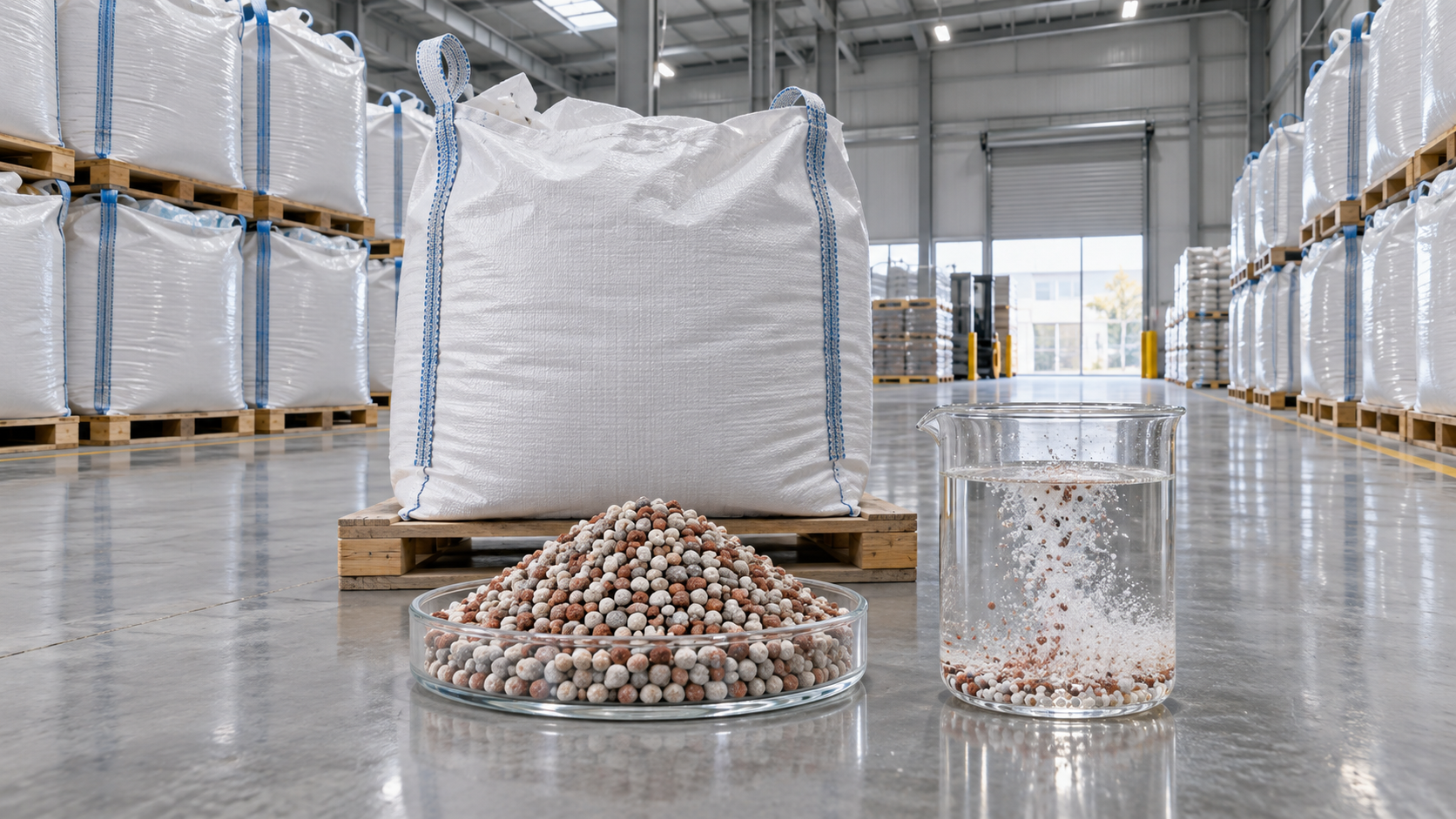
Particle-size distribution is one of the most practical specifications in a Diammonium Phosphate purchase. It influences spreader accuracy, blend uniformity, dust generation, and segregation risk.
Granular DAP for broad-acre application commonly needs a narrow and consistent size range so that particles travel similarly through centrifugal spreading equipment.
If DAP is blended with urea, muriate of potash, sulfate of potash, or micronutrient granules, similar particle sizes reduce separation during loading, transport, and field spreading.
A blend may appear uniform at the plant but segregate inside trucks, bags, hoppers, or spreaders when component particle size and density differ significantly.
Technical specifications should define the percentage retained within the desired screen range, along with maximum limits for fines, dust, oversized granules, and broken particles.
Excess fines can cause dust losses, handling discomfort, caking, and poor spread patterns. Oversized particles may also produce uneven distribution or block equipment components.
Where precision application is required, request representative particle-size test data for several production batches rather than relying on a single historical report.
Packaging and transport conditions matter as well. Repeated handling can generate fines, especially if granules have weak crushing strength or poor resistance to abrasion.
Control Moisture, Caking, and Storage Stability
Moisture content affects the storage behavior of Diammonium Phosphate. Excess moisture increases the chance of caking, agglomeration, package damage, and reduced flowability.
The acceptable moisture limit depends on grade, coating system, climate, packaging format, and expected storage duration. It should be explicitly stated in the purchase specification.
Hot and humid destinations require particular attention. Product that remains free-flowing in dry warehouse conditions may cake after long sea transport or port storage.
Technical evaluators should ask whether the material includes an anti-caking treatment and whether the coating is suitable for the planned storage temperature and humidity range.
Bulk shipments demand different controls from 25-kilogram or 50-kilogram bags. Bulk material may require covered storage, dry conveyors, and faster turnover after discharge.
For bagged cargo, evaluate bag strength, liner configuration, palletization, container loading method, and protection against condensation during ocean transportation.
Container sweat can introduce moisture even when the fertilizer leaves the production site in acceptable condition. Desiccant plans and shipping-season controls may reduce this risk.
A sound receiving inspection should record package condition, visible lumps, free-flowing behavior, moisture results, and representative samples before the material enters production or distribution.
Understand Soil Reaction and Ammonia Risk
DAP creates an alkaline microzone around the granule immediately after application because ammonium and phosphate reactions temporarily raise local soil pH.
This localized reaction can increase the risk of ammonia injury when DAP is placed too close to germinating seeds, especially in dry soils or low-buffering conditions.
The risk is not identical across all fields. Soil moisture, cation exchange capacity, organic matter, planting depth, fertilizer rate, and crop sensitivity all influence outcomes.
For seed-placed applications, technical teams should follow locally validated safe rates rather than applying general recommendations from another crop, soil type, or climate zone.
Banding DAP away from the seed can improve phosphorus access while reducing the likelihood of ammonia-related seedling damage. Placement geometry should match planter capability.
Broadcast incorporation may be more appropriate where application rates are high, soil phosphorus is low across the field, or equipment cannot maintain safe starter bands.
DAP should not be treated as a substitute for agronomic planning. The product specification supports performance, but placement and rate decisions determine much of its practical value.
Review Contaminants and Regulatory Requirements
Destination-market compliance is a procurement requirement, not an administrative afterthought. Fertilizer regulations may set limits for heavy metals, labeling, product registration, and nutrient declarations.
Cadmium is often a priority concern in phosphate fertilizers because its concentration can vary according to phosphate rock source and manufacturing route.
Other parameters may include arsenic, lead, mercury, chromium, fluoride, biuret where relevant, and radionuclide-related requirements under certain national frameworks.
Technical evaluators should identify mandatory limits before requesting quotations. A lower-priced DAP grade may be unsuitable if its impurity profile cannot satisfy the importing country’s rules.
Request recent third-party laboratory reports when regulatory thresholds are strict or when the product will be supplied into food-chain-sensitive agricultural markets.
Documentation should identify the product grade, batch or lot number, analytical results, manufacturing origin, packing details, and traceability information connecting shipment documents to tested material.
Labels should state nutrient analysis using the required local format, net weight, manufacturer information, handling instructions, and any mandated cautionary or registration statements.
Where products are re-packed or blended after import, confirm that traceability remains intact and that final labels accurately reflect the formulation delivered to growers.
Compare Suppliers Beyond the Quoted Price
A technical evaluation should compare total supply reliability, not just the price per metric ton. Inconsistent analysis or delayed deliveries can disrupt seasonal fertilizer programs.
Ask whether the supplier controls production directly, works with approved manufacturers, or sources through multiple channels. Each model requires different quality assurance procedures.
For trading and export suppliers, valuable capabilities include factory qualification, batch verification, pre-shipment inspection, export documentation, and coordination of compliant international logistics.
Shandong Honghuida Chemical Co., Ltd. supports overseas chemical buyers through product sourcing, specification alignment, inspection coordination, packaging options, documentation, and shipment arrangements.
For Diammonium Phosphate procurement, buyers should provide their target analysis, particle-size requirement, moisture limit, package type, destination port, and anticipated annual volume.
A complete request for quotation reduces ambiguity and helps suppliers identify suitable manufacturing sources, evaluate lead times, and quote freight and packaging on a comparable basis.
Before approving a new supplier, request a sample or pre-shipment sample from the actual production source. Laboratory analysis should be compared against contract specifications.
Inspection plans should define sampling methods, laboratory responsibilities, acceptance criteria, dispute procedures, and whether loading inspection is required for each shipment.
Build a Practical DAP Approval Checklist
A robust approval process starts with agronomic requirements. Define crop, soil test results, phosphorus target, nitrogen contribution, application rate, placement method, and timing.
Next, convert those needs into a written product specification. Include guaranteed nutrient analysis, minimum available phosphate, water solubility expectations, particle-size range, and maximum moisture.
Add contaminant limits based on destination regulations and customer policy. These limits should be confirmed before purchase order issuance, not after cargo is loaded.
Specify the packaging format, bag marking, pallet requirements, container loading preference, and storage conditions expected after arrival at the destination.
Evaluate supplier evidence, including certificates of analysis, manufacturing details, quality-system information, inspection records, and prior export experience for the relevant market.
Use an independent inspection organization when shipment value, regulatory exposure, or quality risk justifies added verification. Sampling should occur according to an agreed standard.
Finally, assess field performance after commercial use. Track spread pattern, product flow, crop establishment, tissue nutrient status, yield response, and user feedback across representative sites.
This feedback loop allows technical evaluators to distinguish between a grade that passes laboratory testing and a grade that consistently supports the intended soil fertility outcome.
Conclusion
The best Diammonium Phosphate grade is the one that fits a defined agronomic program while meeting measurable requirements for nutrient analysis, solubility, granule quality, moisture, and compliance.
Technical evaluators should prioritize documented specifications, batch consistency, equipment compatibility, and destination-market requirements instead of selecting DAP based on nominal grade or price alone.
By combining soil data, application planning, product testing, and disciplined supplier qualification, buyers can reduce procurement risk and support more reliable phosphorus and nitrogen management.
Send Us Your Inquiry Today
Honghuida Chemical is a professional chemical product supplier with ample stock of all chemical categories and excellent quality, welcome your purchase inquiry.