
NEWS & INSIGHTS
Chemical Industry Updates & Company News

Send Us A Message
Fertilizer Procurement: Comparing Nutrient Cost, Solubility, and Storage Losses
A fertilizer quote is only useful after it is converted into the cost of usable nutrient at the point of application. Two products may carry the same nutrient label or appear similar on a price-per-ton basis, yet deliver very different value once nutrient concentration, solubility, caking risk, transport losses, and handling requirements are included.
For procurement teams, the practical objective is not to buy the lowest-priced fertilizer. It is to secure a product that supplies the required nutrients in a form the crop and application system can use, arrives in specification, remains manageable during storage, and does not create avoidable cost after delivery.
Start with delivered nutrient cost, not price per metric ton
The first comparison should convert each offer into a common nutrient basis. This prevents a low-analysis product from looking cheaper simply because it contains more carrier material, moisture, or non-nutrient mass.
For a single-nutrient fertilizer, the basic calculation is:
Delivered nutrient cost = delivered product price / nutrient fraction
If the delivered price includes freight, insurance, inland handling, duties where applicable, bagging, and expected loss, those costs belong in the calculation. A product with a favorable FOB price may become less competitive after destination-port charges, repacking, or extra storage work.
For compound and blended fertilizers, compare the cost contribution of each required nutrient rather than treating the NPK grade as one undifferentiated number. A 15-15-15 fertilizer and a 20-10-10 fertilizer cannot be compared directly unless the buying requirement and intended application rate are clear. One may be suitable for a balanced basal program; the other may create an unnecessary phosphorus or potassium gap that must be corrected with another product.
It is also useful to separate the purchase decision into two questions: what nutrient quantity is required over the season, and what product form can be received and used without disrupting operations. The least expensive nutrient source is not automatically the least expensive operating choice.
Solubility matters only in relation to how the fertilizer will be applied
“Soluble” is often used as a shorthand for quality, but it is not a universal purchasing criterion. The right level of solubility depends on whether the product will be dissolved in irrigation water, applied as a dry granule, incorporated into soil, or used in a foliar program.
For fertigation and water-soluble fertilizer programs, rapid and complete dissolution is a functional requirement. Insoluble residue can block filters, clog emitters, settle in stock tanks, or create uneven nutrient delivery. Here, buyers should examine not only the stated nutrient grade but also dissolution behavior under the available water quality, mixing sequence, and tank concentration. A product that dissolves acceptably in clean water may perform poorly in hard water or when mixed with incompatible materials.
For dry field application, the question changes. Granule size, hardness, dust level, moisture resistance, and spreading uniformity can be as important as water solubility. A highly soluble material may be suitable, but it may also be more prone to moisture pickup and caking if warehouse conditions are poor. Slow or controlled-release products add another distinction: their value depends on whether the release pattern matches the crop cycle and soil conditions. They should not be purchased merely because they reduce the number of applications in theory.
Check compatibility before approving a fertilizer for blending or tank mixing
Blended fertilizer procurement requires attention to physical compatibility. Granules with very different sizes, densities, or shapes can segregate during conveying and transport. The blend may test correctly at loading but distribute unevenly in the field. Fine particles create dust and may concentrate in one part of a bag or bulk pile; weak granules may break during handling.
Chemical compatibility matters in liquid systems. Some combinations can form precipitates, especially where phosphate-containing materials meet calcium or magnesium sources. Acid-base interactions can also change solution stability. Procurement specifications should state the intended use, including whether the material is for dry blending, fertigation, liquid formulation, or direct application. That information gives the supplier a meaningful basis for proposing an appropriate grade and packaging format.
Storage losses are often physical losses disguised as quality problems
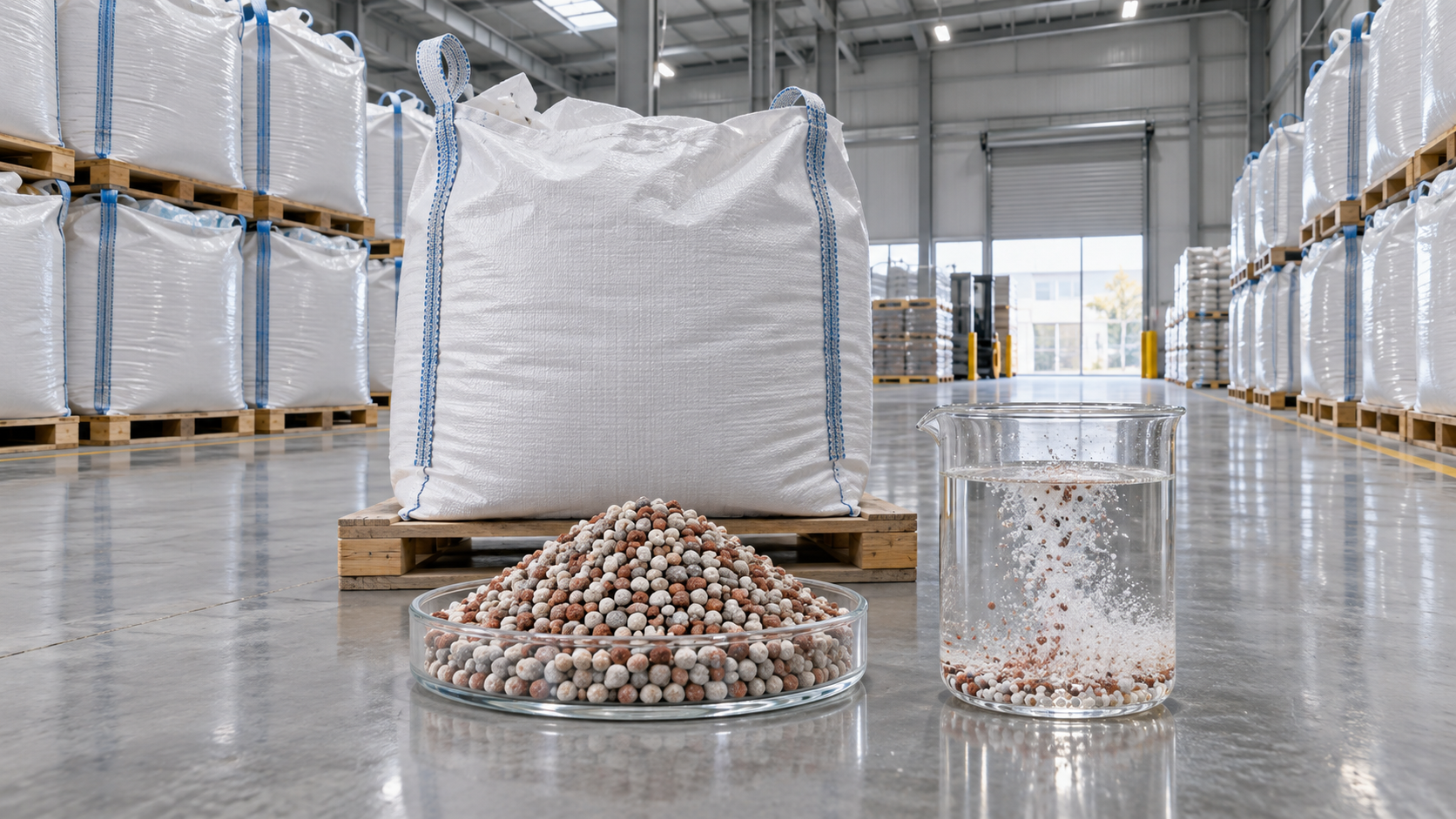
Fertilizers do not all deteriorate in the same way. Some absorb moisture readily, some cake under pressure, some lose free-flowing properties after repeated temperature changes, and some are vulnerable to bag damage or contamination. These risks are especially relevant in long transit routes, humid ports, uncovered transfer points, and warehouses with weak moisture control.
Caking does not necessarily mean the nutrient analysis has disappeared. It can still create a commercial loss because product must be broken, screened, repacked, or discarded when it can no longer pass through spreading or dosing equipment. In bulk handling, lumps may interrupt conveyor flow and increase labor. In bagged supply, a damaged liner or poorly sealed valve can allow moisture entry even if the outer bag appears intact.
Loss prevention begins in the purchase specification. Define the required packaging type, net weight tolerance, palletization where needed, liner requirement, moisture protection, bag marking, and loading method. For products expected to remain in storage for extended periods, require practical evidence of physical condition at dispatch, such as clear loading photos, batch identification, and inspection records. These controls are more useful when they are linked to an agreed acceptance standard rather than collected as routine paperwork.
Storage planning should also reflect product behavior. Keep hygroscopic fertilizers away from wet floors and unprotected doors; avoid mixing damaged bags with sound stock; use stock rotation; and do not stack beyond the packaging supplier's recommended handling limits. A procurement contract cannot correct losses caused by unsuitable warehouse practices after arrival.
Choose the product form around the operating constraint
The product selection becomes clearer when the procurement team identifies the constraint that is most expensive to solve.
- Where application equipment is limited: select a product with particle size and flow properties that match existing spreaders, blenders, or dosing equipment. Changing equipment settings, rescreening material, or hand-breaking caked product can outweigh a small price difference.
- Where irrigation is the delivery method: prioritize reliable dissolution, low insoluble residue, and compatibility with the water source and fertilizer program.
- Where freight is a major share of cost: higher nutrient concentration may reduce shipment volume, bags, handling movements, and storage footprint, provided the formulation fits the agronomic requirement.
- Where storage is long or climate is humid: give greater weight to packaging integrity, moisture resistance, and the supplier's ability to load dry, free-flowing material.
- Where local blending is planned: assess granule uniformity, segregation risk, and whether every component remains stable through transport and blending.
This approach avoids a common error: buying a fertilizer grade because it is readily available, then spending more to adjust its nutrient balance or make it usable in the local system.
Build a procurement specification that suppliers can quote consistently
Vague requests such as “best price for fertilizer” produce quotations that are difficult to compare. A workable request should identify the nutrient grade, product form, intended application method, target quantity, acceptable packaging, destination port or delivery location, and desired shipment period. Where physical quality is important, add requirements for granule range, moisture condition, free-flowing appearance, dust level, or water-insoluble residue as appropriate for the product and application.
Ask for the certificate of analysis, safety and transport documentation applicable to the shipment, packing details, production or batch traceability, and an inspection arrangement before loading. The goal is not to create unnecessary administration. It is to make sure the quoted product, the approved sample where used, and the shipped cargo refer to the same commercial specification.
For international supply, logistics needs to be considered early. Fertilizers may be supplied in bags, jumbo bags, or bulk form, and the correct option depends on destination handling capacity, local labor, moisture exposure, and onward distribution. A bulk cargo can reduce packing cost but becomes unattractive where the receiving terminal or warehouse cannot protect it from moisture and contamination. Small bags can improve downstream handling but add packaging volume, loading time, and disposal requirements.
Use supplier evaluation to reduce variability, not just negotiate price
A capable supplier should be able to explain the origin, grade, packing arrangement, inspection process, and shipment plan in terms that match the buyer's use case. This is particularly valuable when sourcing from multiple producers or when the destination market has specific labeling, documentation, or packaging needs.
Shandong Honghuida Chemical Co., Ltd. supports overseas chemical procurement with sourcing, sample coordination, quality inspection, customized packaging, documentation, customs handling, and shipment booking. For fertilizer-related inquiries, the useful starting point is a complete technical and logistics brief: required nutrient grade, application method, packaging preference, destination, expected storage period, and any blending or dissolution requirements. That allows product selection and shipment planning to be evaluated together rather than as separate transactions.
Before issuing a purchase order, compare offers on one worksheet that includes delivered nutrient cost, physical suitability, expected storage exposure, packing, payment terms, shipment schedule, and inspection conditions. The lowest line-item price may still win, but it should win after those variables have been made visible. That is the basis for buying fertilizers that remain cost-effective from loading point to field application.
Send Us Your Inquiry Today
Honghuida Chemical is a professional chemical product supplier with ample stock of all chemical categories and excellent quality, welcome your purchase inquiry.